

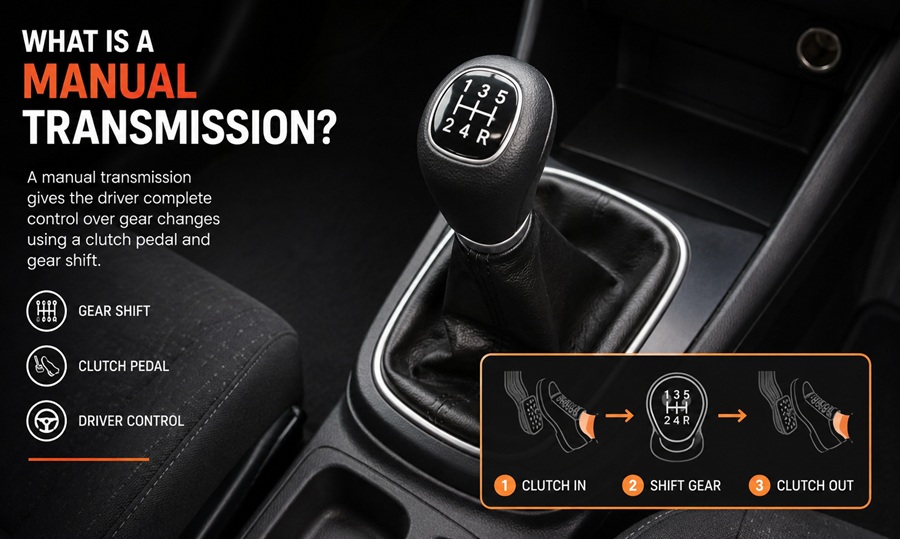

A manual transmission, also called a stick shift or standard transmission, is a gearbox that requires the driver to manually select gears using a clutch pedal and gear shifter, rather than letting the car shift automatically. It gives the driver direct control over engine power at every speed. Manual transmissions were once standard in most cars; today they’re a smaller but still available option, popular with drivers who want more involvement in how the car performs and who value the lower cost and mechanical simplicity that come with fewer electronic components.
How Does a Manual Transmission Work?
A manual transmission connects the engine to the wheels through a set of gears that the driver selects by hand. Pressing the clutch pedal temporarily disconnects the engine from the transmission, which lets you shift gears without grinding them. Releasing the clutch while giving the engine gas reconnects power smoothly to the wheels.
Inside the gearbox, sets of gears of different sizes control how much torque and speed reach the wheels. Lower gears (first, second) give more torque for starting and climbing, while higher gears (fourth, fifth, sixth) let the engine run at lower RPM for efficient highway cruising.
A part called the synchromesh helps match the speed of the gears during a shift, which is why modern manual transmissions shift far more smoothly than older ones from decades past.
Most manual transmissions in passenger cars today have five or six forward gears plus reverse, though some performance cars offer more. The shifter pattern, usually etched into the top of the knob, shows which direction moves you into each gear — a small diagram that becomes second nature after a few weeks of driving.
Manual vs Automatic Transmission: What’s the Real Difference?
The core difference is who decides when to shift. In a manual, the driver chooses the gear and controls the clutch. In an automatic, a hydraulic or electronic system monitors speed and engine load and shifts gears without driver input.
Automatics have become the default in most new cars sold in the U.S. because they’re easier to drive in traffic and simpler to learn. Manuals remain common in sports cars, some trucks, and budget-focused compact models, where drivers value the extra control or the lower purchase price manual versions often carry.
There’s also a middle category worth knowing about: the automated manual and dual-clutch transmission. These use the same gear layout as a traditional manual but shift automatically using a computer and hydraulics, giving drivers manual-style engine control without a clutch pedal. They’re common in some performance and European models but operate differently enough that driving one feels closer to an automatic in daily use.
Is It Hard to Learn a Manual Transmission?
Learning to drive a manual takes practice, mainly around coordinating the clutch and gas pedal so the car doesn’t stall or lurch. Most new drivers stall a handful of times in the first few practice sessions, especially on hills, and that’s a normal part of the learning curve rather than a sign something’s wrong.
Finding an empty parking lot for the first few hours of practice, before moving to quiet residential streets, helps build the muscle memory needed before tackling hills or heavy traffic.
Hill starts trip up almost every new manual driver at first, since the car tends to roll backward the instant the brake is released unless the clutch and gas are timed correctly. Many newer manual cars include hill-hold assist, which briefly holds the brakes after release, giving beginners an extra second to coordinate the clutch and throttle without rolling.
Pros and Cons of Driving a Manual Car
Manual transmissions tend to cost less to buy and repair, since the mechanical design is simpler than an automatic’s torque converter and electronic controls. Many drivers also find manuals more engaging, since they control exactly when and how the car shifts, which some enthusiasts prefer for spirited or performance driving.
On the downside, manuals require more physical coordination, which makes stop-and-go traffic more tiring. They can also be harder to resell in markets where automatic transmissions dominate, since fewer buyers know how to drive one.
There’s also a theft-deterrent side benefit some owners mention: because fewer people know how to drive a manual, a manual-equipped car can be a less appealing target in areas with higher vehicle theft rates, though this is a minor factor compared to the driving experience itself.
Are Manual Transmissions Still Available in 2026?
Yes, though the selection has narrowed. Manual transmissions are still offered on select sports cars, some compact hatchbacks, and certain trucks, but they’ve become rare on mainstream sedans and SUVs. Buyers who specifically want a manual usually need to check trim-level availability, since many automakers now offer it only on base or performance trims.
Maintenance Tips for Manual Transmissions
Manual transmissions generally need less maintenance than automatics, but a few habits extend their life. Avoid resting your foot on the clutch pedal while driving, since even light pressure causes unnecessary wear on the clutch disc.
Check your owner’s manual for the recommended interval to change the manual transmission fluid, typically every 30,000 to 60,000 miles depending on the vehicle. And avoid using the clutch to hold the car on a hill — use the brake instead, which spares the clutch from excess heat and wear.
Who Should Consider Buying a Manual Transmission Car?
A manual makes the most sense for drivers who do most of their driving on open roads rather than heavy city traffic, since the repeated clutch work in stop-and-go conditions is the main downside. Enthusiasts who enjoy an active role in how the car accelerates and slows down also tend to prefer manuals, particularly in sports cars where rev-matching and gear selection are part of the driving experience.
It’s less practical for someone who splits time between multiple drivers who don’t know how to operate a clutch, or for anyone commuting daily through dense traffic where an automatic’s convenience outweighs the manual’s control and lower repair costs.
Frequently Asked Questions
What does ‘stick shift’ mean?
Stick shift is another name for a manual transmission, referring to the gear shifter lever the driver moves by hand to change gears, working together with the clutch pedal.
Do manual cars get better gas mileage than automatics?
This used to be generally true, but modern automatic transmissions with more gears and computer-controlled shifting often match or beat manual fuel economy today. The gap that once favored manuals has mostly closed.
Why do some drivers prefer manual transmissions?
Many drivers enjoy the added control over gear selection and engine braking, along with the lower repair costs and, for some, the simple enjoyment of a more hands-on driving experience.
Can automatic transmission drivers easily switch to manual?
Yes, with practice. The main adjustment is learning clutch control, which usually takes a few hours of focused practice in a low-traffic area before it starts to feel natural.
Is a manual transmission more reliable than an automatic?
Manuals tend to have fewer components that can fail and lower repair costs when something does go wrong, since there’s no torque converter or complex hydraulic control system. Reliability still depends heavily on maintenance and driving habits for either type.