

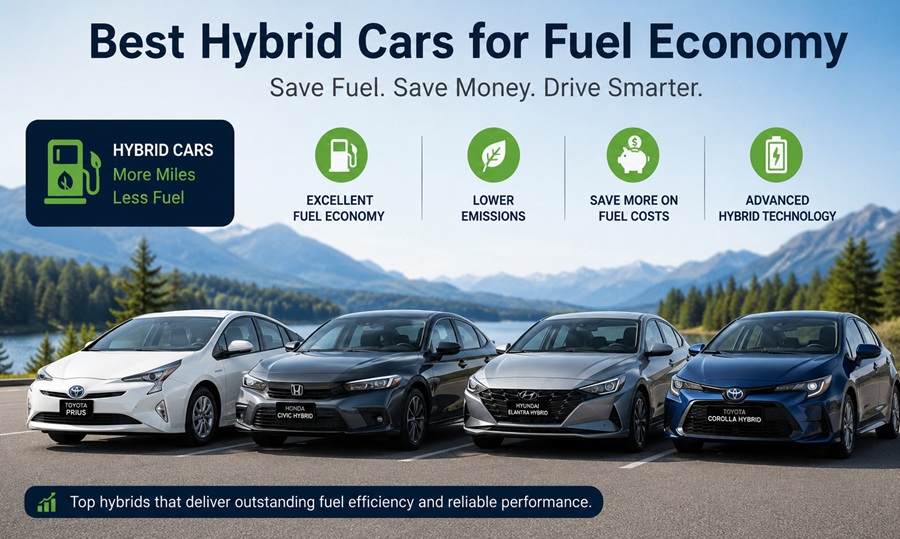

The most fuel-efficient hybrids on the market right now include the Toyota Prius, Hyundai Ioniq, Toyota Corolla Hybrid, Honda Civic Hybrid, and Kia Niro Hybrid, with several of these regularly landing over 50 combined miles per gallon in real-world driving. Compact hybrid sedans tend to beat hybrid SUVs on pure MPG, though SUVs close the gap if cargo space or all-wheel drive matters more to you than squeezing out every last mile per gallon. Here’s a full cost and options breakdown to help narrow down the right one.
What Actually Makes a Hybrid Fuel-Efficient?
Three things drive hybrid fuel economy: a smaller gas engine that leans on the electric motor for low-speed driving, regenerative braking that recaptures energy instead of wasting it as heat, and overall vehicle weight. Lighter compact hybrids generally out-perform heavier hybrid SUVs and trucks, even when the underlying hybrid technology is similar.
Cost Breakdown: Sticker Price vs. Long-Term Fuel Savings
Upfront cost. Compact hybrid sedans in the U.S. typically start between $24,000 and $29,000, a premium of roughly $1,500 to $3,000 over the gas-only version of the same model. Hybrid SUVs usually start higher, in the $30,000 to $38,000 range.
Fuel savings over time. A driver covering 12,000 miles a year in a 50-MPG hybrid spends roughly $960 annually on gas at $4 per gallon, compared to about $1,600 for a comparable 30-MPG gas-only vehicle. That’s a savings of around $640 a year, which usually covers the hybrid price premium within three to five years for most buyers.
Maintenance costs. Hybrid batteries are built to last 8 to 10 years or 100,000 to 150,000 miles in most cases, and manufacturers typically back them with warranties covering that same range. Brake pad life also tends to run longer on hybrids because regenerative braking reduces wear on the physical brake components.
Compact Hybrids vs. Hybrid SUVs: What’s the Tradeoff?
Compact hybrid sedans win on pure fuel economy, often reaching the mid-to-high 50s combined MPG. Hybrid SUVs generally land in the low-to-mid 30s to low 40s combined, still a significant jump over their gas-only counterparts, but not as dramatic as what a sedan delivers. The tradeoff comes down to cargo room, ground clearance, and towing capacity versus the lowest possible fuel bill.
| Vehicle Type | Typical Combined MPG | Starting Price Range | Best For |
| Hybrid SUV | 33-41 MPG | $30,000-$38,000 | Families, cargo space |
| Plug-In Hybrid | 40+ MPG (gas) / 25-40 mi electric | $28,000-$36,000 | Short daily commutes |
Buyers cross-shopping a compact hybrid against a hybrid SUV should factor in how much of their driving is genuinely short-trip and city-based. A sedan’s fuel economy advantage shrinks quickly on long highway hauls, where the two body styles perform more similarly than the sticker numbers suggest.
Do Hybrid Cars Cost More to Insure?
Should insurance costs factor into the decision?
Hybrid insurance premiums tend to run slightly higher than gas-only equivalents, usually by $50 to $150 a year, mainly because hybrid components like the battery pack and electric motor cost more to repair or replace after an accident. This difference is small compared to the fuel savings over a typical ownership period, but it’s worth including when comparing total cost of ownership rather than just the price at the pump.
Hybrid vs. Plug-In Hybrid: Which One Actually Saves More?
Should you consider a plug-in hybrid instead?
A plug-in hybrid (PHEV) can save more on fuel than a standard hybrid, but only if you charge it regularly and your daily driving stays within its electric-only range, typically 25 to 40 miles. For drivers with a short commute and access to home charging, a PHEV can mean weeks of driving on electricity alone. For drivers who mostly do highway miles or can’t charge reliably, a standard hybrid usually delivers a better return without the added complexity.
Real-World MPG vs. EPA Estimates
Why does my hybrid get lower MPG than the sticker says?
EPA estimates come from controlled lab testing that doesn’t fully account for cold weather, aggressive acceleration, or heavy highway use. Hybrids are especially sensitive to this gap because their fuel savings rely heavily on low-speed, stop-and-go conditions where the electric motor does more of the work. City driving often gets closer to the EPA number, or even beats it, while sustained highway speeds usually fall a bit short.
Options by Budget and Use Case
Best for tight budgets: The Toyota Corolla Hybrid and Honda Civic Hybrid both offer strong fuel economy at some of the lowest starting prices in the hybrid segment, making them practical first choices for daily commuters.
Best for maximum MPG: The Toyota Prius remains one of the most efficient options on sale, built specifically around fuel economy rather than retrofitted onto an existing gas model.
Best for families needing space: The Toyota RAV4 Hybrid and Kia Niro Hybrid balance solid fuel economy with more cargo room and rear-seat space than a compact sedan offers.
Best for short commuters with home charging: A plug-in hybrid like the Toyota Prius Prime lets drivers with a daily commute under 40 miles run almost entirely on electricity, using gas mainly for longer trips.
Best for highway-heavy commutes: Hybrids generally lose less of their fuel-economy edge on the highway than a full electric vehicle loses in range, but the gap between city and highway MPG is still worth checking model by model. Drivers who spend most of their time on the interstate should compare highway-specific EPA numbers rather than the combined figure, since combined ratings can overstate real highway performance by several MPG.
What to Check Before Buying
A few practical steps make comparison shopping faster and more accurate:
- Compare EPA city, highway, and combined ratings side by side, not just the headline combined number
- Ask for the vehicle’s actual hybrid battery warranty length and mileage cap in writing
- Test drive during both stop-and-go traffic and highway speeds if possible, since hybrid MPG varies more by driving condition than gas-only cars
- Check whether the trim level changes the drivetrain, since some hybrid trims add all-wheel drive that lowers fuel economy
- Look up current manufacturer or state incentives, since plug-in hybrids sometimes qualify for tax credits that standard hybrids don’t
Frequently Asked Questions
Do hybrid cars really save money in the long run?
Yes, for most drivers who keep the car for at least three to five years and drive a normal amount of city and highway miles. The fuel savings gradually offset the higher upfront price.
Is a hybrid worth it if gas prices are low?
It still can be, since hybrids typically hold their resale value well and require less brake maintenance over time, but the payback period on fuel savings alone will take longer.
Do hybrid batteries need to be replaced?
Most hybrid batteries last the life of the vehicle, often 150,000 miles or more, and are covered by long manufacturer warranties. Replacement is uncommon within the warranty period.
Which hybrid gets the best gas mileage overall?
The Toyota Prius consistently ranks among the highest combined MPG figures in its class, though exact numbers vary by trim and drivetrain configuration.