

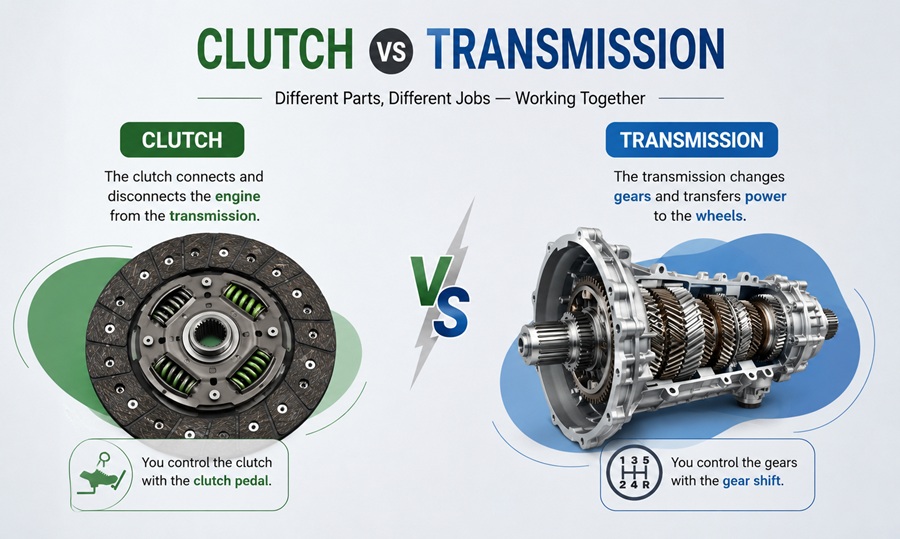

The clutch and transmission are two separate parts that work together but do different jobs: the clutch engages and disengages power between the engine and transmission, while the transmission changes gears to control speed and torque. In a manual car, you feel both directly — the clutch pedal and the gear shifter. Understanding the difference matters most when something starts feeling off, since clutch problems and transmission problems have different symptoms, causes, and repair costs, and misdiagnosing one for the other can lead to paying for the wrong repair.
What Does the Clutch Do?
The clutch sits between the engine and the transmission. Its job is to connect or disconnect engine power so gears can be changed without grinding. When you press the clutch pedal, spring pressure releases and the clutch disc separates from the flywheel, cutting the connection to the engine.
Release the pedal gradually, and the clutch disc re-engages with the flywheel, transferring power back to the transmission and wheels. This friction-based connection is what lets a manual car pull away smoothly from a stop instead of stalling or lurching.
The clutch itself is made up of a few core parts: the clutch disc, the pressure plate, and the release bearing. The pressure plate clamps the disc against the flywheel using spring tension, and the release bearing is what moves when you press the pedal, relieving that clamping force. Wear happens gradually on the disc’s friction material, similar to how brake pads wear down over time.
What Does the Transmission Do?
The transmission takes the power the clutch delivers and routes it through a set of gears to control how fast the wheels spin relative to the engine. Lower gears multiply torque for acceleration; higher gears let the engine spin slower at highway speed, saving fuel and reducing wear.
In an automatic car, this same job happens without a clutch pedal — a torque converter and computer-controlled system handle engagement and gear changes on their own. In a manual car, the driver manages both jobs directly.
Inside the transmission housing, gear sets of different sizes mesh together to produce each gear ratio. Transmission fluid lubricates these gears and keeps them running cool, which is why low or degraded fluid is one of the most common causes of rough or delayed shifting, separate from any clutch-related issue.
How the Clutch and Transmission Work Together
Think of the clutch as a switch and the transmission as a set of levers. The clutch has to disengage first so the transmission’s gears can shift without clashing, then re-engage to send power through whichever gear you selected.
This sequence happens dozens of times on a normal drive — every stop, every gear change, every hill. Because they operate as a pair, problems in one often get mistaken for problems in the other, which is why diagnosis matters before assuming a costly transmission repair is needed.
A mechanic typically starts by isolating which system is at fault, sometimes by checking for clutch slippage on a test drive (revving without matching acceleration) before pulling the transmission apart. This step alone can save a driver from paying for transmission labor when the actual problem, and the far less expensive fix, is the clutch.
Signs of a Failing Clutch vs a Failing Transmission
| Symptom | More Likely Clutch | More Likely Transmission |
| Burning smell when accelerating | Yes | Rare |
| Grinding noise when shifting | Sometimes | Yes |
| Gears slip out of position while driving | No | Yes |
| Spongy or high clutch pedal | Yes | No |
| Delayed or rough engagement | Yes | Yes |
| Fluid leaking under the car | Rare | Yes |
A burning smell is one of the clearest clutch signals, usually caused by slipping — when the clutch disc can’t fully grip the flywheel, generating friction heat. Gears that pop out of position on their own, on the other hand, point more toward internal transmission wear.
Can You Drive with a Bad Clutch or Transmission?
Technically, yes, for a short distance, but it’s not advisable. A slipping clutch gets worse the longer you drive on it, and continuing to drive can eventually leave you stranded when it fails to engage at all.
Transmission problems carry more risk. Driving with low or contaminated transmission fluid, or ignoring grinding gears, can cause damage that turns a moderate repair into a full transmission rebuild or replacement.
If a car won’t go into gear at all, or the clutch pedal drops to the floor with no resistance, it’s best to have the vehicle towed rather than risk driving it. Both symptoms suggest a failure point that could leave you stuck mid-drive rather than in a parking lot.
Repair Cost Comparison
Clutch replacement on most compact and mid-size cars typically runs $800 to $1,500 for parts and labor, since the transmission usually has to be removed to access the clutch. Transmission repairs vary far more widely — a minor fix like a solenoid or fluid service might cost a few hundred dollars, while a full manual transmission rebuild can run $1,500 to $3,500, and replacement can exceed that depending on the vehicle.
Because clutch replacement often requires similar labor to a transmission repair, some mechanics recommend replacing both if the clutch has significant mileage, to avoid paying for the same labor twice down the road.
How to Extend the Life of Both Systems
Riding the clutch — resting a foot on the pedal while driving, or holding the car on a hill using half-clutch instead of the brake — is the single biggest cause of premature clutch wear. The friction material burns off faster under constant partial engagement than it does from normal shifting.
For the transmission, following the manufacturer’s fluid change interval matters more than most drivers realize, since degraded fluid loses its ability to lubricate and cool the gears effectively. Shifting gears fully, rather than rushing between gears without a complete clutch press, also reduces strain on both systems and helps them last closer to their full expected mileage.
Frequently Asked Questions
Is the clutch part of the transmission?
No, though they’re closely connected. The clutch is a separate component that sits between the engine and the transmission, managing the connection between them rather than being part of the gear-changing mechanism itself.
What does a slipping clutch feel like?
A slipping clutch often feels like the engine revs higher than usual without a matching increase in speed, especially under acceleration or going uphill, sometimes paired with a burning smell.
Do automatic cars have a clutch?
Most traditional automatics use a torque converter instead of a manual clutch, though some automated manual and dual-clutch transmissions do use clutch packs, just controlled by the car’s computer instead of a pedal.
How long does a clutch typically last?
A clutch typically lasts between 60,000 and 100,000 miles, though this varies widely based on driving habits, especially frequent stop-and-go traffic or aggressive clutch use, which shortens its lifespan.
Why does replacing a clutch cost so much if the part itself is affordable?
Most of the cost comes from labor, not parts, since accessing the clutch usually means removing the transmission from the vehicle. That labor-intensive process is why shops often recommend replacing related wear components, like the release bearing, at the same time.