
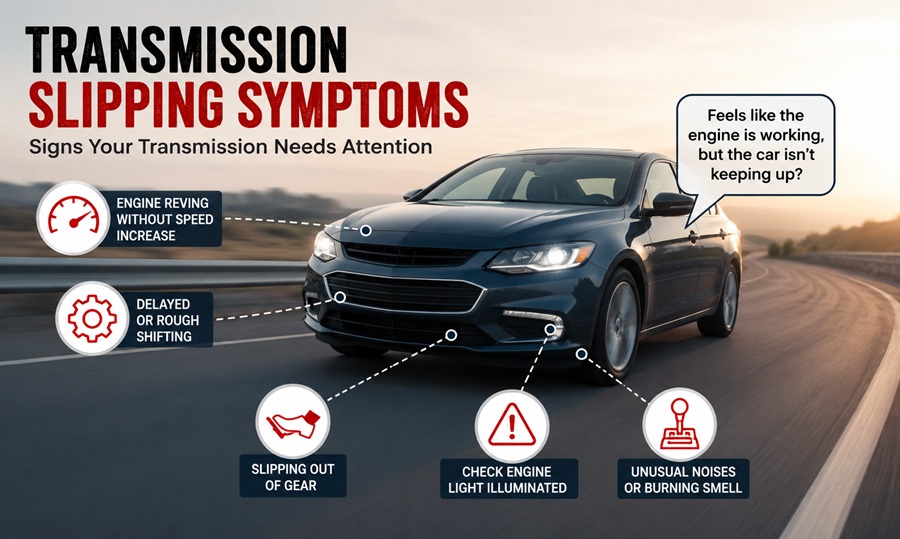

Transmission slipping happens when the engine’s power isn’t fully transferring to the wheels, causing symptoms like the engine revving higher than normal without matching acceleration, delayed or rough gear changes, and a burning smell from low or degraded fluid. It affects both automatic and manual transmissions, though the underlying causes differ between the two. Ignoring these symptoms usually leads to a much larger repair bill down the road.
Myth vs. Reality
Myth: Transmission Slipping Always Means You Need a New Transmission
Many drivers assume slipping is an automatic death sentence for the transmission, but that’s often not true. In many cases, the cause is something far simpler and cheaper to fix, like low or burnt fluid, than a fully worn-out transmission requiring replacement. A fluid and filter service resolves a meaningful share of early slipping complaints without any internal repair needed at all.
Myth: Slipping Only Happens in Old, High-Mileage Vehicles
While age and mileage increase the risk, slipping can also occur in newer vehicles due to a manufacturing defect, low fluid from a leak, or a software issue affecting shift timing in modern automatic transmissions. Some newer vehicles with continuously variable transmissions, or CVTs, can also exhibit slip-like symptoms from belt or pulley wear, which is a different failure mode than traditional automatic transmissions.
Myth: A Transmission Flush Fixes Every Slipping Problem
Flushing the fluid helps when degraded fluid is the root cause, but it won’t repair mechanical wear inside worn clutch packs, bands, or solenoids. Some drivers flush the fluid, see the symptoms return within a few weeks, and mistakenly conclude the flush didn’t work, when in reality the underlying mechanical issue was never addressed.
Reality: Fluid Condition Is the Most Common Cause
Low or degraded transmission fluid is behind a large share of slipping cases. Fluid that’s old, contaminated, or simply too low no longer provides proper hydraulic pressure or lubrication, which causes clutches and bands inside the transmission to slip instead of gripping firmly. Fluid that has turned dark brown or smells burnt has typically broken down chemically and lost much of its protective ability, even if the level itself still looks adequate on the dipstick.
What Does Transmission Slipping Feel Like?
The most noticeable sign is the engine revving up without a corresponding increase in speed, almost like the car is momentarily disconnected from the wheels. Other signs include gears that shift late, shift with a hard jolt, or slip between gears unexpectedly while cruising at a steady speed. Some drivers describe a brief hesitation when pressing the gas from a stop, almost like a delay before the car actually responds, which is another common presentation of early-stage slipping.
Why Does a Transmission Slip?
Low or Burnt Transmission Fluid
This is the most common and often the cheapest cause to fix. Fluid naturally degrades with heat and age, and a simple fluid and filter change can resolve early-stage slipping in many cases. Stop-and-go city driving and towing both generate more heat than steady highway cruising, which accelerates fluid breakdown for drivers in those situations.
Worn Clutch Plates or Bands
Inside an automatic transmission, clutch packs and bands engage and disengage to change gears. Over time, these wear down and lose their grip, causing slipping that a fluid change alone won’t fix. This type of wear is progressive, meaning symptoms typically start subtle and worsen gradually over weeks or months rather than appearing suddenly.
Manual Transmission Clutch Wear
In manual vehicles, slipping almost always points to a worn clutch disc that can no longer create enough friction to transfer power fully, especially noticeable when accelerating hard or climbing a hill. This is a normal wear item that every manual transmission vehicle eventually needs replaced, typically somewhere between 60,000 and 100,000 miles depending on driving style.
Solenoid or Sensor Issues
Modern automatic transmissions rely on solenoids and sensors to control shift timing and pressure. A failing solenoid can cause symptoms that feel like slipping even when the internal mechanical parts are fine. This is actually good news when it turns out to be the cause, since solenoid replacement is typically far cheaper than clutch pack or band repair.
Low or Contaminated Fluid From a Leak
A slow leak from a worn seal or gasket can gradually starve the transmission of fluid without an obvious puddle appearing under the car every time you park. Checking fluid level regularly, not just when symptoms appear, can catch this before it causes slipping in the first place.
Is It Safe to Keep Driving with a Slipping Transmission?
Driving short distances at low speeds with mild slipping is usually not immediately dangerous, but continuing to drive normally, especially at highway speeds or under load, risks turning a minor issue into complete transmission failure. Sudden loss of power while merging or passing is also a real safety concern, so it’s best to get it checked as soon as symptoms appear. A transmission that slips severely enough to lose drive entirely can leave you stranded in traffic, which is a far worse outcome than scheduling a repair proactively.
How Much Does It Cost to Fix?
A fluid and filter service to address early slipping typically costs $150 to $250. If the issue involves worn internal components like clutch packs, a repair can run $1,000 to $3,000. A full transmission replacement, needed in more severe cases, often costs $3,000 to $5,000 or more depending on the vehicle. Getting a second opinion is worth it for any estimate above $1,500, since diagnosis quality varies significantly between shops and a more thorough inspection sometimes reveals a cheaper fix than initially quoted.
Practical Advice: What to Do When You Notice Slipping
Start with the simplest and cheapest possibility first. Check the transmission fluid level and color, since fluid that looks dark or smells burnt is a strong clue and an easy fix. If the fluid looks and smells normal, it’s time to have a technician run a diagnostic scan, since many modern vehicles store error codes related to shift performance even before symptoms become obvious to the driver.
Don’t wait until the symptoms worsen. Transmission repairs caught early, while the issue is still fluid-related rather than mechanical, are dramatically cheaper than waiting until internal components fail completely. Keeping a simple log of when symptoms occur, such as only when cold or only under heavy acceleration, gives a technician valuable diagnostic information and can shorten the time needed to pinpoint the cause.
Frequently Asked Questions
Can low transmission fluid cause permanent damage?
Yes, if the fluid stays low for an extended period, the resulting friction and heat can permanently damage internal components that would otherwise have been fine with proper fluid levels.
Does transmission slipping happen suddenly or gradually?
It’s usually gradual, starting with occasional, mild symptoms that worsen over weeks or months, though fluid loss from a sudden leak can cause it to appear more quickly.
Will a transmission flush fix slipping?
It can help in early cases caused by degraded fluid, but a flush won’t repair worn clutch plates, bands, or solenoids, which need mechanical repair instead.
Is transmission slipping the same in CVTs as traditional automatics?
Not exactly. CVTs use belts and pulleys instead of clutch packs and bands, so slipping in a CVT usually points to belt wear or fluid issues specific to that design rather than the same internal components found in a traditional automatic.