
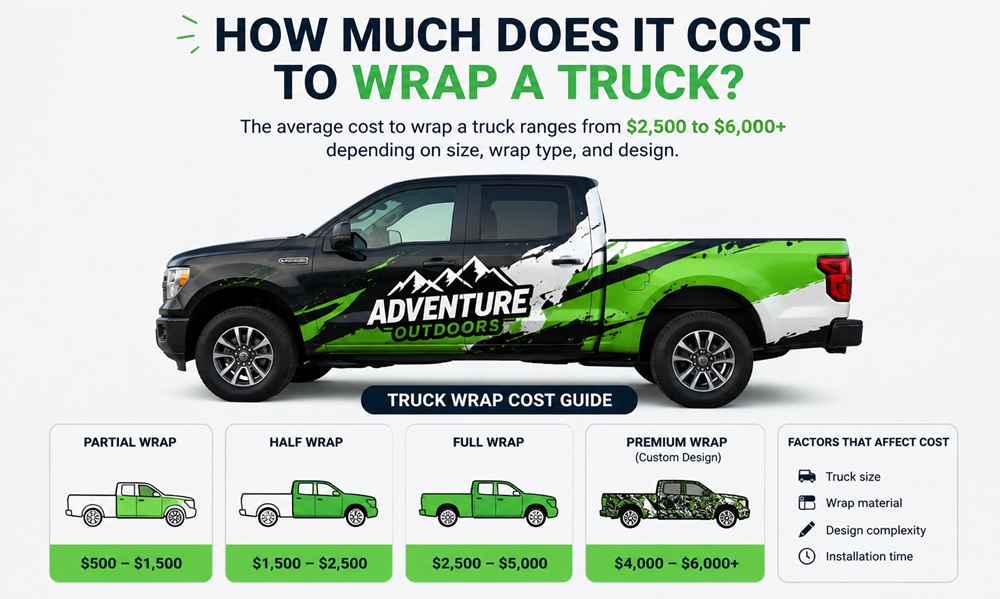

A local plumbing contractor recently wrapped his three-truck fleet to boost brand visibility around town. His pickup trucks each cost about $3,800 for a full wrap, while his larger box truck ran closer to $6,500 due to its size and the extra graphics work for the company logo and phone number. That real-world example lines up with typical industry pricing: truck wraps generally cost $3,000 to $8,000 depending on vehicle size and coverage.
Here’s a closer look at what shaped his costs, and what any business or individual should expect to pay for a truck wrap, along with the practical lessons he picked up along the way.
What the Contractor Learned About Pricing
Before getting quotes, he assumed all three trucks would cost roughly the same. That turned out to be wrong. His pickups, being smaller with simpler body panels, wrapped faster and cheaper. The box truck’s flat panels actually made design and printing easier, but its sheer surface area drove up material costs, since box trucks can require 150 to 250 square feet of vinyl compared to roughly 60 to 80 square feet for a standard pickup.
He also learned that a full wrap wasn’t necessary for his goals. His installer suggested a partial wrap covering the doors, tailgate, and rear panel, which would have cut costs by nearly 40% while still delivering strong visibility for a moving billboard effect. He opted for full wraps anyway because he wanted maximum brand consistency across the fleet, and because he planned to keep the trucks for at least five years, which made the extra upfront cost feel justified against the wrap’s expected lifespan.
Cost by Truck Type
| Truck Type | Average Wrap Cost |
| Compact pickup | $2,800–$4,000 |
| Full-size pickup | $3,500–$5,000 |
| Cargo van | $3,500–$5,500 |
| Box truck (16–24 ft) | $5,000–$8,000+ |
Larger fleet vehicles with complex curves or multiple access doors, like utility trucks, tend to land at the higher end of these ranges due to added labor time. A box truck with a walk-in cargo door and multiple side compartments, for instance, can take an installer two to three full days versus one day for a straightforward pickup wrap.
Full Wrap vs. Partial Wrap vs. Decals
A full wrap covers the entire truck and offers the most branding impact, but it’s also the most expensive option. A partial wrap, covering doors and rear panels, delivers strong visibility at a lower cost and works well for businesses on tighter budgets. Simple decals with just a logo and contact information cost the least, often under $500, but offer far less visual presence on the road.
Many fleet owners land on a middle-ground approach: a partial wrap on the sides and rear, paired with a printed decal on the hood, which balances visibility with cost. This combination typically runs 50% to 65% of a full wrap’s price while still covering the panels most visible to other drivers and pedestrians.
Is a Truck Wrap Worth It for Business Advertising?
Industry studies on vehicle advertising suggest a wrapped commercial vehicle can generate tens of thousands of visual impressions per day in moderate traffic areas, making it one of the more cost-effective advertising formats per impression. For a service business like plumbing, HVAC, or landscaping, a wrapped truck essentially becomes free advertising every time it’s parked at a job site or driving between calls.
The contractor in this example calculated that his $3,800 pickup wrap would need to generate roughly two new customer leads to pay for itself, based on his average job value. He hit that within the first month, largely from neighbors of existing job sites who called after seeing the truck parked nearby, which he tracked by asking new customers how they’d heard about his business.
Lessons for Anyone Considering a Truck Wrap
Get quotes from at least two or three installers, since pricing can vary significantly based on regional labor rates and the shop’s experience with commercial fleet work. Ask to see examples of straight lines and clean edges around door handles and mirrors in their past projects, since that’s where lower-quality installations show flaws first.
Also budget for design work separately if you don’t already have print-ready graphics. Many wrap shops include basic design in their quote, but complex branding with multiple design revisions can add $200 to $500 to the total project cost. Requesting a physical color proof before full production, rather than approving off a digital mockup alone, is a small step that prevents costly reprints if the final colors look different once printed on vinyl.
How Long Do Truck Wraps Last?
A quality cast vinyl wrap on a commercial truck typically lasts 5 to 7 years with regular hand-washing and garage storage when possible. Trucks that sit outside in direct sun year-round, particularly in hot climates, may see fading or edge lifting closer to the 4 to 5 year mark. Fleet vehicles that log high daily mileage, especially highway miles, also tend to show wear on leading edges like the hood and front bumper sooner than the rest of the wrap.
Choosing the Right Installer
Look for a certified installer, ideally one certified by a major vinyl manufacturer like 3M or Avery Dennison, since certification typically comes with a manufacturer-backed warranty on both material and installation. A workmanship warranty separate from the material warranty is a strong signal you’re working with an experienced shop.
Fleet Discounts Worth Asking About
If you’re wrapping more than one vehicle, most shops offer a per-truck discount for fleet orders, often 5% to 15% off individual pricing once you commit to three or more vehicles. The contractor in this example negotiated a modest discount on his third truck simply by mentioning he was getting all three done at once, which is a common and reasonable ask.
Bundling design work across multiple vehicles also saves money, since the shop can reuse the same logo files and layout template rather than starting from scratch for each truck.
Maintenance Tips to Extend a Truck Wrap’s Life
Hand-washing with a pH-neutral soap, rather than running trucks through automatic car washes with abrasive brushes, preserves the vinyl’s finish and edges significantly longer. Parking in shade or a garage when possible slows down UV fading, particularly on darker colors, which tend to fade faster than lighter ones under constant sun exposure.
Small edge lifts around door handles or mirrors should be addressed quickly by the original installer, since a small lifted corner can spread if dirt and moisture get underneath, eventually requiring a more costly repair or early replacement.
When Removal or Replacement Makes Sense
Most wrap shops recommend replacing a wrap once fading, cracking, or edge lifting becomes widespread rather than isolated to a small area, typically somewhere in year 5 to 7 for cast vinyl. Waiting too long past that point can make removal harder, since aged adhesive sometimes bonds more tightly to the paint and requires more careful, time-consuming removal to avoid damaging the clear coat underneath.