
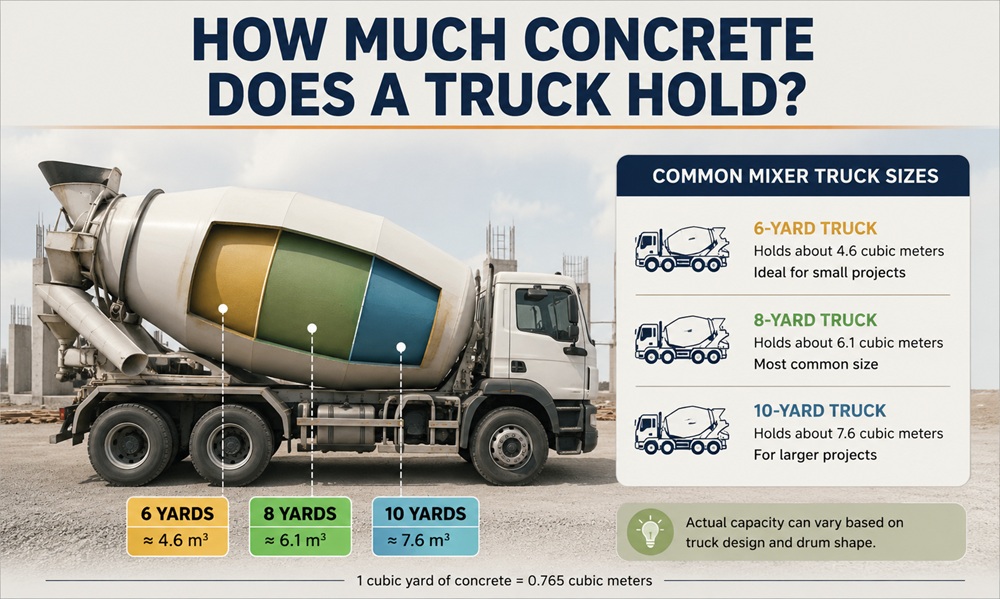

A standard ready-mix concrete truck holds about 8 to 10 cubic yards of concrete, though drum capacity technically maxes out closer to 11 cubic yards. Most concrete companies fill trucks to around 9 cubic yards on a typical delivery to leave room for mixing agitation during transport. If you’re planning a project and need to know how many truck loads you’ll need, this guide walks through the basics from start to finish.
Concrete Truck Capacity for Beginners
Ready-mix trucks, the rotating drum trucks you see on highways and job sites, are built around a standard capacity range. Most full-size trucks max out at 10 to 11 cubic yards, but companies rarely load them to full capacity because the mix needs room to rotate and stay properly agitated during the drive to your site. A drum spinning at 2 to 6 revolutions per minute during transit keeps the concrete from separating or beginning to set before it reaches the pour location.
Smaller “mini-mix” trucks exist for jobs that don’t need a full load. These typically carry 1 to 4 cubic yards and are common for smaller residential projects like a single sidewalk section or a small patio repair. Mini-mix trucks are also narrower and more maneuverable, which makes them useful for job sites with tight driveway access where a full-size truck simply can’t fit.
How Many Cubic Yards Do You Actually Need?
To estimate your project’s concrete needs, multiply the length, width, and depth of your pour (all in feet), then divide by 27 to convert cubic feet into cubic yards. A 10-foot by 10-foot patio poured at 4 inches deep (0.33 feet) works out to about 1.2 cubic yards.
For a driveway, a garage slab, or anything larger than a small patio, you’ll likely need a full truck delivery or possibly more than one, depending on the total volume required. A typical two-car driveway, roughly 20 feet by 20 feet at 4 inches thick, needs close to 5 cubic yards, while a standard garage slab of similar dimensions but poured at 5 inches thick lands closer to 6.2 cubic yards.
Common Mistakes When Ordering Concrete
Underestimating the amount needed. Many first-time DIYers calculate the exact cubic yardage and order that amount precisely, without accounting for uneven ground, form settling, or spillage. Concrete suppliers generally recommend ordering 5% to 10% more than your calculated volume to avoid running short mid-pour, which can create a visible seam in the finished slab.
Not checking site access for a full-size truck. A fully loaded concrete truck is heavy, often 60,000 to 70,000 pounds combined, and requires a stable, accessible route to your pour site. Steep driveways, soft ground, or narrow alleys can prevent a full-size truck from getting close enough, forcing you to use a pump truck or smaller mini-mix instead, sometimes at extra cost.
Ignoring how quickly concrete sets. Once concrete is mixed and loaded, you generally have about 90 minutes before it becomes too stiff to work with properly. Ordering more than your crew can pour and finish within that window leads to wasted material and rushed, lower-quality finishing work. Hot weather shortens this window further, sometimes to 60 minutes or less, which is why many contractors schedule large summer pours early in the morning before temperatures peak.
Are There Smaller Concrete Trucks for Small Jobs?
Yes. Mini concrete trucks, sometimes called volumetric mixers, carry smaller loads and mix concrete on-site rather than arriving pre-mixed. This is useful for small jobs because you only pay for the exact amount you use, rather than ordering a minimum load from a full-size truck, which many suppliers require to be at least 1 to 2 cubic yards minimum regardless of your actual need.
Volumetric mixers also offer more flexibility for adjusting the mix design on-site, such as adding extra cement or admixtures for a specific finish, since the ingredients are combined at the job site rather than pre-batched at a plant.
How Much Does a Full Truck of Concrete Weigh?
A cubic yard of concrete weighs roughly 4,000 pounds. A full 10-cubic-yard load weighs around 40,000 pounds, plus the weight of the truck itself, which brings the total combined weight to well over 60,000 pounds on the road. This is worth knowing if you’re concerned about a truck driving across a driveway, since older or thinner driveways can crack under that weight, and many contractors will avoid driving a loaded truck directly onto an existing driveway for this reason, opting instead to pump or chute the concrete from the street.
Next Steps: Ordering Concrete for Your Project
Start by calculating your project’s exact cubic yardage using the length-by-width-by-depth formula, then add a 5% to 10% buffer. Call at least two local ready-mix suppliers to compare pricing per cubic yard, which typically runs $150 to $200 depending on your region and the concrete mix strength required.
Confirm truck access to your site before ordering, and ask your supplier whether a pump truck will be needed if the mixer truck can’t get close enough to pour directly. Finally, schedule your delivery with enough labor on-site to place and finish the concrete within that 90-minute working window after it arrives.
What Is the Minimum Order for a Concrete Delivery?
Most ready-mix suppliers set a minimum order, commonly 1 to 2 cubic yards, and charge a short-load fee if your project falls below that threshold. This fee can range from $50 to $150, since dispatching a full-size truck for a small load isn’t cost-efficient for the supplier regardless of the actual concrete volume used.
If your project only needs a fraction of a cubic yard, bagged concrete mix from a hardware store or a volumetric mini-mixer are usually more economical than ordering a partial truck load.
How Do Multiple Truck Loads Work for Large Projects?
For projects requiring more concrete than a single truck can carry, such as a large driveway or foundation slab, suppliers schedule sequential truck deliveries timed closely together so the pour stays continuous. This prevents visible “cold joints,” which happen when one section of concrete begins setting before the next section is poured against it.
Coordinating multiple trucks requires clear communication with your supplier about your crew’s pouring pace, since arriving too early backs up trucks waiting to unload, while arriving too late risks the previous batch setting before the next arrives. On larger commercial pours, suppliers sometimes stagger truck arrivals 15 to 20 minutes apart specifically to match a crew’s realistic placement speed.