

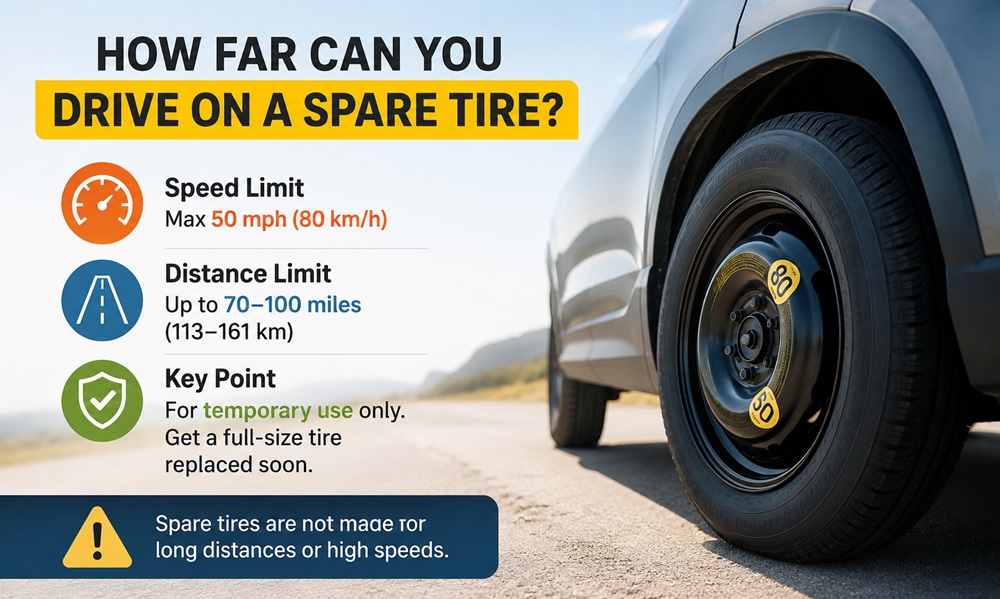

Most compact spare tires, often called donuts, are only rated for about 50 to 70 miles at speeds under 50 mph. That limit exists because donut spares are thinner, lighter, and built for temporary use, not daily driving. A full-size matching spare can be driven much farther, closer to normal tire mileage, since it’s built the same as your regular tires.
Here’s a fast breakdown of what to check before you rely on your spare for a longer trip.
Donut Spare vs. Full-Size Spare vs. Run-Flat Tires
A compact donut spare is smaller in diameter and narrower than your regular tires, which keeps it light and easy to store but limits how far and how fast you can safely drive on it. A full-size spare matches your regular tire size and can typically be driven like a normal tire, though it’s still smart to get your flat repaired soon.
Run-flat tires are a different category entirely. They’re designed to keep you driving even after a puncture, usually up to 50 miles at reduced speed, without needing a spare at all. If your car has run-flats, check your manual, since the mileage limit differs from a traditional spare.
What Happens If You Exceed the Spare Tire’s Limit?
Driving too far or too fast on a compact spare can cause it to overheat, wear unevenly, or fail outright, since it wasn’t built to handle sustained speed or distance. It can also strain your transmission on all-wheel-drive vehicles, because the spare’s smaller diameter creates a rotation mismatch with your other three tires.
How Long Can a Spare Tire Sit Before It’s Unsafe to Use?
Spare tires age even without being driven on. Rubber degrades over time, so a spare older than six to ten years may be unsafe regardless of tread depth. Check the DOT date code on the sidewall — a four-digit number showing the week and year it was made — before trusting it in an emergency.
Detailed Guide: Using Your Spare the Right Way
After installing the spare, drive gently and avoid hard acceleration, sharp turns, or sudden braking, since the smaller tire changes your car’s handling balance. Head straight to a tire shop rather than running errands first. Most shops can patch a repairable puncture in under 30 minutes for $15 to $25, which is far cheaper than replacing a tire outright.
Before you even leave the roadside, double-check that the spare is properly seated and that all lug nuts are tightened in a star pattern, then re-torqued once you’ve driven a few miles. A spare that’s slightly loose can work itself further loose over the first several miles of driving, so it’s worth a quick stop to recheck.
If your flat isn’t repairable, such as a sidewall puncture or a blowout, you’ll need a full replacement. Buying just one new tire can also throw off tread depth matching on all-wheel-drive vehicles, so ask the shop whether your car needs a matching pair or full set.
What Does a Spare Tire Situation Typically Cost?
A simple puncture repair on your original tire usually runs $15 to $25 and takes less than half an hour, making it by far the cheapest outcome. A single replacement tire typically costs $80 to $200 depending on the brand and size, while a full set replacement runs $400 to $800 for most sedans and crossovers.
If you don’t already own a spare, a new compact donut spare with a wheel typically costs $100 to $150, while a full-size matching spare can run $150 to $300 depending on your vehicle. Given the cost difference, most drivers find the compact spare a reasonable trade-off for the storage space it saves.
Quick Checklist
- Check your owner’s manual or the spare’s sidewall for the exact mileage and speed rating
- Never exceed 50 mph on a compact donut spare
- Check spare tire pressure before driving — most need 60 PSI, much higher than regular tires
- Inspect tread depth if the spare has been sitting unused for years
- Get your flat tire repaired or replaced as soon as possible, ideally within a day or two
Tips
- Keep your spare properly inflated year-round — check it during routine tire pressure checks
- Replace a spare tire that’s over 10 years old even if it looks unused
- Avoid highway driving on a donut spare whenever possible; take back roads to the tire shop instead
- Carry a portable tire inflator or plug kit as a backup for minor punctures
- Keep a basic tire pressure gauge in your glove box so you can check the spare before relying on it
- Note your spare’s exact mileage and speed limit from the sidewall so you don’t have to guess mid-trip
Frequently Asked Questions
Can I drive on the highway with a spare tire?
It’s not recommended on a compact donut spare, since most are limited to 50 mph. A full-size spare can typically handle highway speeds.
How fast can you drive on a spare tire?
Most compact spares are rated for a maximum of 50 mph. Check the sidewall of your specific spare to confirm.
Do I need to replace all four tires if I use my spare?
No, but if your car is all-wheel drive, mismatched tread depth on one new tire can cause drivetrain strain over time.
Can I put a spare tire on the front wheel instead of the rear?
Yes, a compact spare can go on any wheel position in most vehicles, though some manufacturers recommend specific placement. Check your owner’s manual to confirm.