

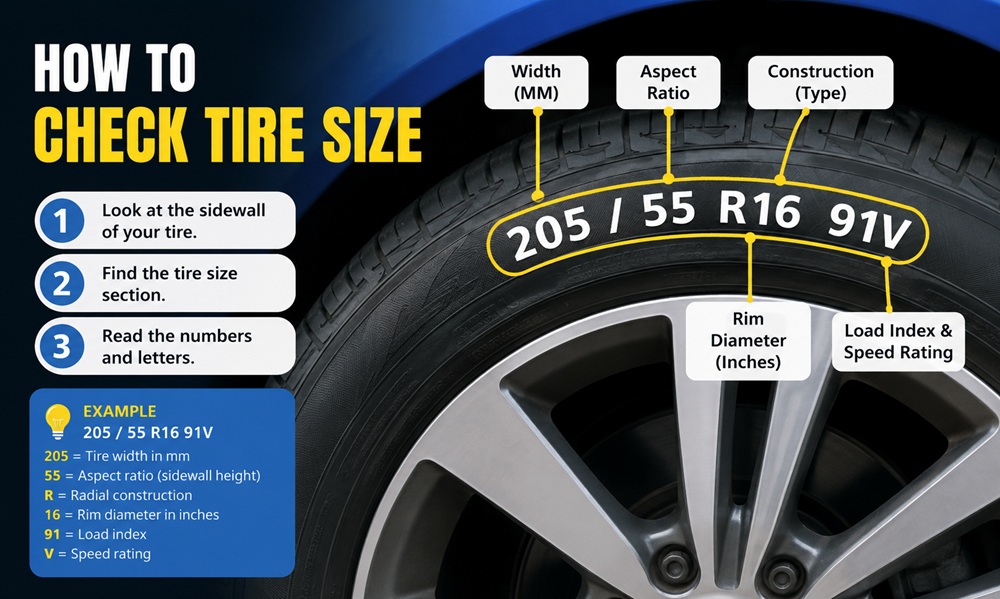

The fastest way to check your tire size is to look at the sidewall of your tire, where you’ll find a code like P215/65R16. That code tells you the tire’s width, height ratio, construction type, and rim diameter, all the numbers you need to buy a matching replacement. You can also find this same size listed on a sticker inside your driver’s door jamb or in your owner’s manual.
Here’s how to read every part of that code so you know exactly what you’re looking at.
Where to Find Your Tire Size
Check three places, in this order of reliability: the tire sidewall itself, the placard sticker inside the driver’s door jamb, and your owner’s manual. The sidewall shows the size of the tire currently mounted, which may not always match the automaker’s original recommendation if a previous owner changed tires.
The door jamb sticker shows the manufacturer’s recommended size and also lists the correct tire pressure, which is useful information to have on hand anyway.
Breaking Down the Tire Size Code
A typical code looks like P215/65R16 91H. Each part means something specific:
- P — Tire type (P for passenger vehicle, LT for light truck)
- 215 — Tire width in millimeters, measured sidewall to sidewall
- 65 — Aspect ratio, meaning the sidewall height is 65% of the tire’s width
- R — Radial construction, the standard for nearly all modern tires
- 16 — Rim diameter in inches that the tire is built to fit
- 91 — Load index, showing the maximum weight the tire can safely carry
- H — Speed rating, showing the tire’s maximum safe sustained speed
What Is the Load Index and Speed Rating?
The load index is a number code that corresponds to a maximum weight per tire, found on a standard reference chart; a common rating like 91 corresponds to roughly 1,356 pounds. The speed rating is a letter showing the tire’s top sustained speed, with H rated for up to 130 mph. Both numbers matter for safety and should match or exceed your vehicle manufacturer’s original specification.
Speed ratings run from lower letters like S (112 mph) and T (118 mph), common on economy sedans, up through H, V, and higher ratings found on performance cars. Choosing a lower speed rating than your original tires won’t affect normal city or highway driving, but it can slightly change handling feel and isn’t recommended if your vehicle came from the factory with a higher rating.
Common Mistakes When Checking Tire Size
- Reading an old, worn sidewall where numbers have faded and guessing instead of confirming
- Assuming all four tires match, especially on a car that’s had one tire replaced separately
- Confusing the tire’s current size with the automaker’s original recommended size
- Ignoring the load index and speed rating when buying a replacement, which can affect handling and safety
- Mixing up width (215) with rim diameter (16), since both are just numbers on the sidewall
Can You Change to a Different Tire Size?
In some cases, yes, within a small range that keeps the tire’s overall diameter close to the original. Going too far outside your recommended size can throw off your speedometer accuracy, affect handling, and in some cases trigger warning lights tied to traction control. If you want a different size, ask a tire shop to confirm it’s a safe fit for your specific vehicle.
Next Steps: Buying the Right Replacement Tires
Once you have your full code, write it down or take a photo of the sidewall so you have it on hand when shopping. Most tire retailers let you search directly by this code, and matching it exactly ensures the new tire fits your rims correctly and performs the way your vehicle was designed to handle.
If you’re replacing just one or two tires rather than a full set, try to match the same brand and model as your existing tires when possible, since mixing different tread patterns can affect handling and wear evenly across the vehicle.
Do Tire Sizes Ever Come in Metric or Alternate Formats?
Most passenger vehicles in the US use the standard P-metric format described above, but some trucks and specialty vehicles use a Euro-metric or flotation size format instead, such as 33×12.50R15 for many off-road truck tires. If your sidewall doesn’t match the usual P215/65R16 pattern, a tire shop can help translate it to confirm the correct replacement.
Why Getting the Size Exactly Right Matters
Installing a tire that’s even slightly off from your vehicle’s recommended size can affect more than just appearance. A different overall diameter changes how far your car travels per wheel rotation, which throws off your speedometer and odometer readings. It can also affect how your traction control and anti-lock brake systems interpret wheel speed, since those systems assume all four tires are the same size.
For most daily drivers, sticking to the exact size listed on your door jamb sticker is the safest choice. If you’re considering a size change for looks or off-road capability, talk to a tire professional first to confirm it won’t cause rubbing, clearance issues, or handling problems specific to your vehicle.
Frequently Asked Questions
Is the tire size the same on all four tires?
It should be, unless a previous owner replaced tires separately. Check all four sidewalls to confirm they match.
Where else can I find my tire size besides the sidewall?
Check the sticker inside your driver’s door jamb or your owner’s manual — both list the manufacturer’s recommended size.
What does the R mean in a tire size code?
R stands for radial construction, which describes how the tire’s internal layers are built. Nearly all tires sold today are radial.
Can I look up my tire size online using my vehicle’s make and model?
Yes, most tire retailer websites let you search by year, make, and model. This is useful as a starting point, but always confirm against your actual sidewall since trim levels can vary.