

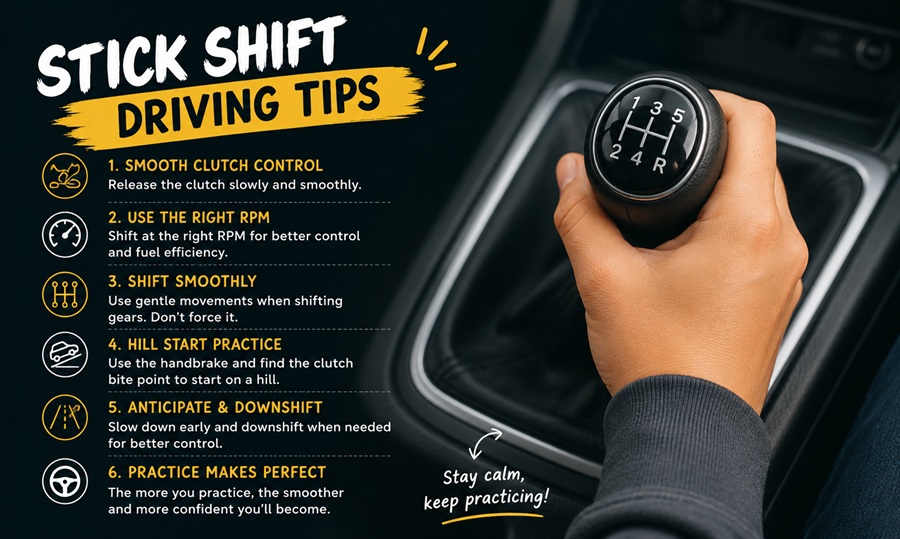

Learning to drive a stick shift comes down to mastering clutch control, timing your shifts with engine sound rather than the speedometer, and practicing in a low-traffic area before tackling hills or city driving. Most new drivers stall a few times in the first hour, and that’s completely normal. With a few focused practice sessions, smooth shifting becomes second nature.
Is Stick Shift Hard to Learn?
It’s harder than automatic at first, mainly because of the coordination needed between the clutch and gas pedal, but most people become reasonably comfortable within a week of regular practice. The learning curve is steepest in the first hour and gets noticeably easier after that. Many drivers describe a specific moment, usually somewhere in their second or third practice session, where the clutch and gas coordination suddenly clicks and stalling becomes rare.
How Do You Avoid Stalling a Manual Car?
Stalling happens when you release the clutch too quickly without enough gas to keep the engine turning over. The fix is to release the clutch slowly while gently adding gas, finding the “friction point” where the car starts to move, and holding that balance for a moment before fully releasing the clutch. Most cars have a fairly wide friction point zone, usually a couple of inches of pedal travel, which gives you more room for error than it might feel like during your first attempts.
Example: A Beginner’s First Practice Session
A typical first lesson happens in an empty parking lot. The driver starts in first gear, slowly lifts the clutch until the car just begins to creep forward, then adds light gas while continuing to release the clutch. After a dozen or so attempts, the stalling becomes less frequent as muscle memory builds. This low-pressure environment is far better than learning in traffic, where stress makes stalling more likely and the pressure of cars waiting behind you can make even simple starts feel harder than they are.
What’s the Best Way to Practice Stick Shift?
Start in an empty parking lot or quiet residential street with no traffic behind you. Practice these skills in order:
- Starting from a stop without stalling
- Shifting from first to second gear smoothly
- Coming to a complete stop and downshifting properly
- Slow-speed maneuvering, like parking, in first gear only
- Stopping and restarting on a flat surface repeatedly until it feels automatic
Once these feel comfortable, move to light traffic on roads with fewer stop signs, then gradually work up to busier streets and highway on-ramps. Give yourself permission to take this progression slowly. Rushing straight into a busy intersection before you’re ready tends to build anxiety that actually slows down the learning process.
Can You Learn Stick Shift in a Weekend?
Most people can grasp the basics of starting, stopping, and shifting through the gears in a single weekend of focused practice, though true confidence in traffic, on hills, and in parking situations usually takes a few weeks of regular driving. Don’t rush straight into rush-hour traffic before you’re comfortable with the fundamentals. A realistic goal for a weekend of practice is being able to start smoothly nine times out of ten and shift through the first three gears without thinking about each individual step.
Hill Starts Without Rolling Back
Example: Handling a Stop Sign on a Hill
A common source of anxiety for new manual drivers is stopping on an incline. The most reliable method is using the handbrake: hold the car in place with the parking brake, bring the clutch to the friction point, add gas, and release the handbrake as the car starts to move forward. This prevents the car from rolling backward into traffic behind you. Some newer manual vehicles include hill-hold assist, which holds the brakes automatically for a couple of seconds, but it’s still worth practicing the handbrake method since not every car has this feature and it’s a skill worth having regardless.
An alternative method some drivers prefer is heel-toe balancing between the brake and gas pedal, but this technique takes more coordination and isn’t necessary for confident, safe hill starts. The handbrake method is more forgiving for beginners and works in essentially any manual vehicle.
City Driving and Stop-and-Go Traffic
Manual driving in heavy traffic takes more attention than automatic, since you’re constantly shifting between first and second gear. Many experienced manual drivers simply stay in first gear during very slow crawling traffic rather than repeatedly shifting up and down, which reduces clutch wear and driver fatigue. Some drivers also learn to “ride” the clutch very slightly at extremely low speeds during true stop-and-go crawling, though this should be minimized whenever possible since it does add extra clutch wear over time.
Downshifting and Rev Matching
Downshifting smoothly when slowing down, rather than just braking in a high gear, helps control speed on descents and keeps the engine in its power band when you need to accelerate again. Rev matching, which means briefly blipping the throttle while downshifting, makes the transition smoother and reduces wear on the clutch and transmission over time. This technique takes practice but becomes intuitive once you’re comfortable with basic shifting. A useful way to practice rev matching is on a quiet road with light traffic, gradually decelerating through second and third gear while listening for a smooth, jolt-free transition between gears.
Highway Driving in a Manual Car
Once you’re comfortable with city driving, highway merging in a manual car mainly requires confidence in second and third gear acceleration to build speed quickly enough to merge safely. Most manual cars can comfortably cruise in fifth or sixth gear at highway speeds with minimal shifting required once you’re up to speed, which makes highway driving noticeably less demanding than navigating stop-and-go city traffic.
Frequently Asked Questions
How long does it take to get comfortable driving stick shift?
Most drivers feel reasonably confident within two to four weeks of regular practice, though full comfort in all conditions, including hills and heavy traffic, can take a couple of months.
Is it bad to ride the clutch while learning?
Yes, even during the learning phase, try to minimize time spent partially engaging the clutch, since it accelerates wear on the clutch disc.
Do I need a specific car to practice on?
Any manual vehicle works for practice, but a car with a light clutch and forgiving friction point, common in smaller economy cars, tends to be easier for beginners than trucks or performance vehicles.
Will I damage the transmission while learning?
Occasional stalling and rough shifts while learning won’t cause lasting damage. The main things to avoid are prolonged clutch riding and repeatedly grinding gears by shifting without fully pressing the clutch.