

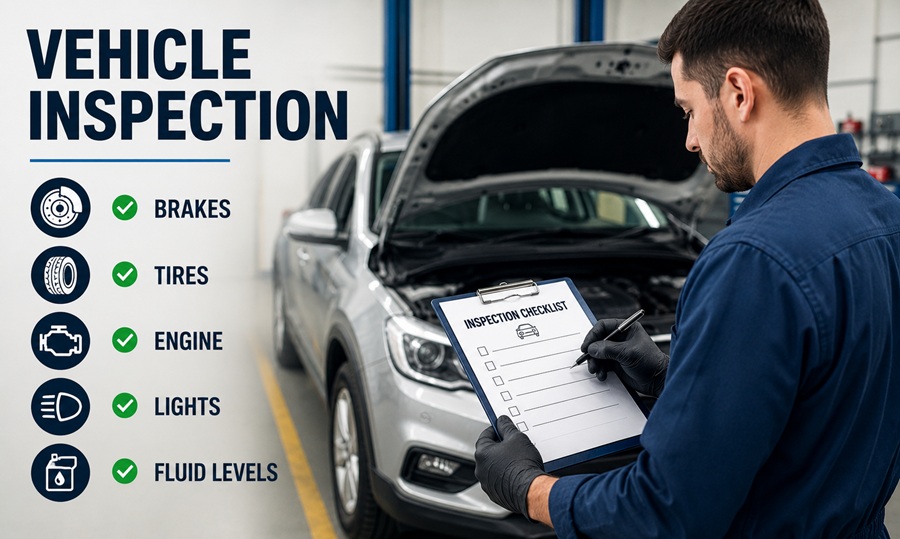

A vehicle inspection is a mandatory or recommended review of a car’s safety and emissions systems, typically covering brakes, lights, tires, steering, and exhaust. Requirements vary widely by state: some require annual safety inspections, others only require emissions testing, and several require no periodic inspection at all. Most inspections take 15 to 30 minutes and cost between $20 and $60, depending on location and inspection type.
Below, we explain what actually gets checked during an inspection, what to prepare beforehand, and what to do if your vehicle doesn’t pass.
What Do They Check in a Vehicle Inspection?
A standard safety inspection reviews the main systems that affect whether a car is safe to drive:
- Brakes (pad thickness, rotor condition, brake lights)
- Tires (tread depth, visible damage, air pressure)
- Lights (headlights, taillights, turn signals, brake lights)
- Windshield wipers and washer fluid
- Windshield condition (cracks in the driver’s line of sight can cause a failure)
- Steering and suspension components
- Horn function
- Mirrors and seatbelts
- Exhaust system, checking for leaks or excessive noise
Emissions inspections focus specifically on how much pollution a vehicle’s exhaust produces, either through a direct tailpipe test or, in newer cars, a scan of the onboard diagnostic (OBD) computer.
How Often Should You Get an Inspection?
This depends entirely on the state you live in. Most states that require inspections do so annually, though some require it every two years or only when transferring vehicle registration. States that don’t require a general safety inspection, including several in the South and West, may still require emissions testing in specific counties, usually the more densely populated ones.
Since the rules genuinely change by state, checking your state’s DMV website directly is the only reliable way to know your exact schedule.
What Happens If Your Car Fails Inspection?
Failing inspection isn’t the end of the process — it’s a temporary hold. Here’s what usually happens next:
- The inspection center gives you a specific list of the items that failed.
- You have a window of time, generally 15 to 30 days depending on the state, to make repairs.
- You return to the same center (in most states) for a free or reduced-cost re-inspection.
- Once the car passes, you receive your inspection sticker or certificate.
The most common failure reasons include worn tires, burnt-out bulbs, and wipers that don’t clean the glass properly — all inexpensive, quick fixes.
Where Can You Get a Vehicle Inspection Done?
Inspections are performed at state-authorized centers, which can be independent mechanic shops, certified service stations, or centers dedicated exclusively to inspections. In many states, not just any shop can perform official inspections — look for an “authorized inspection station” sign or certificate before taking your car in. Your state’s DMV website usually has a locator for nearby centers.
Common Reasons for Failing Inspection
- Ignoring a dashboard warning light. A “check engine” light often causes an automatic failure on the emissions test, even if the car drives fine.
- Worn wiper blades. An easy, cheap fix that many people put off until inspection day.
- Burnt-out bulbs. A single non-working brake light or turn signal is one of the most common individual reasons for failure.
- Low tread depth. Tires below the state’s minimum allowed tread (often 2/32 of an inch) will fail regardless of the rest of the vehicle.
- Cracked windshield in the line of sight. Even a small crack directly in front of the driver can cause a failure in many states.
How to Prepare Before the Inspection
A quick check at home can save you an extra trip to the inspection center.
- Test all exterior lights, including brake lights and turn signals, with someone else watching or by backing up toward a reflective surface
- Check tread depth with a coin or a tread gauge
- Replace wiper blades if they’re cracked, torn, or not cleaning well
- Address any dashboard warning lights before your appointment
- Bring your registration, proof of insurance, and, if your state requires it, proof of a previous inspection
Local Note: Requirements Vary Widely by State
Vehicle inspection requirements are one of the most inconsistent areas of car ownership in the United States. States like New York and Pennsylvania require annual safety inspection statewide. States like Texas eliminated their traditional safety inspection program but still require emissions testing in select counties. Several states, including Montana and South Dakota, don’t require any periodic inspection at all. Because of this variation, it’s worth checking your state’s DMV site directly rather than assuming your previous state’s rules apply after a move.
Frequently Asked Questions
How much does a vehicle inspection cost?
Cost usually ranges between $20 and $60, depending on the state and whether the inspection includes emissions testing, which often has a separate cost from the basic safety inspection.
Can I drive with an expired inspection sticker?
In most states, driving with an expired sticker can result in a fine, and it can also affect insurance claims if you’re in an accident during that period. It’s best to get inspected as soon as possible after it expires.
Do electric vehicles need emissions inspections?
No. Electric vehicles don’t produce tailpipe emissions, so they’re generally exempt from emissions testing, though some states still require a basic safety inspection for EVs.